

18 Jun This is Why I’m Feminist
Three weeks ago in Guyana, a 12-year-old girl, pregnant by her stepfather, gave birth by caesarean section. The newspapers reported that after the surgery she was resting comfortably. I’m not sure what they meant by that. But I know that news made me uncomfortable.
What about her right to a life free of violence?
This is why I’m feminist. Because I know the answers to those questions, and I don’t like them.
For all the attempts to convince me that there is no gender inequality in the region, and that we have made collective peace with the other forms of inequality, I know better.
I know that we view children in a hierarchical relationship to adults. We expect them to be seen and not heard. We tell them to know their place. We fail to protect them on a massive scale.
I was 15, when a man burnt me with a cigarette…
This is why I’m feminist. Because any form of inequality or discrimination needs to be redressed. Because gender inequality cuts across other forms of oppression.
Yes, I’ve heard how strong Caribbean women are, how we’re outnumbering and outperforming men at university, and that many young women are afraid to identify with feminism because they fear it means they won’t get a man. And not only are men in short supply, the singular most important ambition of any young woman’s life should be to get one…I’ve heard. I recognize the tief-head BS for what it is. And I’m still feminist.
Let’s break this down a bit.
Only 10% of Caribbean 18-30-year-olds access tertiary education, according to Sir Hilary Beckles, Principal of the University of the West Indies’ Cave Hill Campus. While we’re busy crunching the sex ratios of university education we’re forgetting the majority of Caribbean people (women and men) who just don’t have access to university. Now I’m not saying that finding out why so many young men are turned off formal education isn’t important. It is.
What I’m saying is that we also need to talk about the 90% of women and men who don’t have access. We need to talk about the Ponzi scheme that is the Common Entrance exam, which most Caribbean children take at age 11. We need to talk about how this system essentially bars many of them from access to education in the first place.
This is why I’m feminist.
This is why I’m feminist.
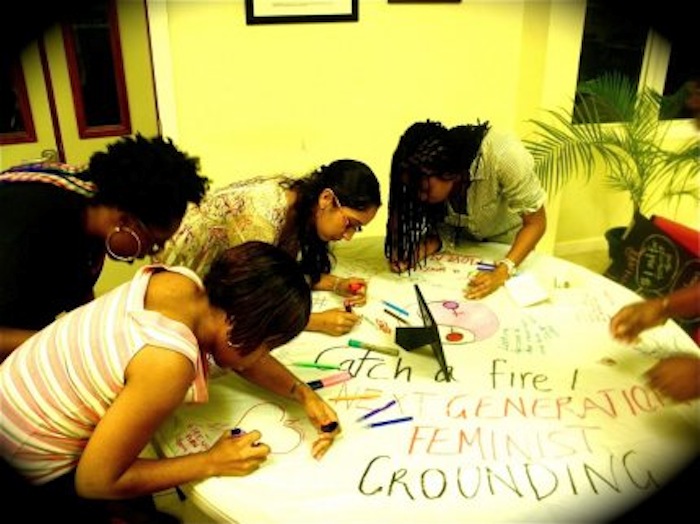
Last month, I co-hosted CatchAFyah New Generation Feminist Grounding with Sherlina Nageer of Red Thread and the Society Against Sexual Orientation Discrimination in Barbados. We did not know what we were doing. We did know that it was important for us as women born in the early 90s, 80s and late 70s to come together, and commit to working to improve our communities and region.
“This gathering was not a meeting,” said Malaika from Grenada. “It was not a conference. It was a truly collective action in and of itself. We were the grounding. We facilitated, documented and shared knowledge. The whole gathering was non-hierarchical and full of love.”
We were fired up about feminism!
We learnt from each other. Tracey-Ann from Jamaica shared that though her mother supported her human rights activism, she had asked her not to appear on television identifying as lesbian. Safety is a daily negotiation among partners, family and community.
Ifasina from Belize shared that because of her organization’s HIV prevention work the groups’ members were stigmatized as all being HIV positive themselves. They persevered out of a sense of conviction for the importance of their work. They went on to not only be awarded by UNAIDS for their community work, but to also win over the community members who now seek them out for the sexuality education, which they provide on location at fetes and parties.
These everyday acts of courage constitute and sustain Caribbean feminism.
At the end of the two days, we did not have all the answers. Or perhaps any of the answers. But we are in it for the long haul, and hope that misconceptions about feminism don’t deter the allies we need.
Outlish writer Brendon O’Brien has argued that the biggest problem facing social change in Trinidad and Tobago is that there’s no sexiness in the struggle. The usual activist methods fail to capture local imagination.
At CatchAFyah we came together across language, nation, religion, ethnicity and sexual orientation. We brought every aspect of who we are as Caribbean people to that space, learning and sharing through art, video, movement, music and yes, even good ole PowerPoint. I can’t say it was sexy, but it was definitely erotic, in the Audre Lorde sense of the term: “The erotic is a measure between the beginnings of our sense of self and the chaos of our strongest feelings. It is an internal sense of satisfaction to which, once we have experienced it, we know we can aspire. For having experienced the fullness of this depth of feeling and recognizing its power, in honour and self-respect we can require no less of ourselves.”
Caribbean feminism is not some giant hairy man-eating monster anxious to claw its way to the top and destroy the family and society in the process. It’s a movement of ordinary diverse women (and men) like the ones I had the privilege of spending two days with: passionate, courageous and committed to being the change they want to see.
Who wouldn’t want to be a part of that?

Hailing from Barbados, Tonya Haynes is the co-ordinator of CODE RED for gender justice, which organized the recent CatchAFyah Feminist Grounding. Twenty-four young feminist activists from across the English-speaking Caribbean and Haiti participated. To connect with CODE RED for gender justice, click the icons below.
Twitter •
Pingback:Outlishly feminist | Feminist conversations on Caribbean life
Posted at 06:25h, 18 June[…] out our article on Caribbean feminism in Outlish Magazine. One CODE RED member discusses why she’s feminist. Share this:Share on TumblrMorePrintDiggEmailLike this:LikeBe the first to like this. […]
Johnny Fkin Traunt
Posted at 14:37h, 18 JuneFuck your one sided agendas all men are not yr enemies
“YES YES WE OUTNUMBER THEM IN SCHOOL NOW !*rubs hand together”
fuck your ideals
Malaika
Posted at 17:19h, 18 JuneReally though, did you read the article or did you just see the word “feminist” and shut off?
“Caribbean feminism is not some giant hairy man-eating monster anxious to claw its way to the top and destroy the family and society in the process. It’s a movement of ordinary diverse women (and men) like the ones I had the privilege of spending two days with: passionate, courageous and committed to being the change they want to see.”
Johnny Fkin Traunt
Posted at 14:54h, 18 Juneone fine day it will be human rights united or some kinda shit so and maybe it would make more sense
Hope Munro Smith
Posted at 16:15h, 18 JuneShe didn’t say that at all. Did you even read the article?
Jaime Lee Loy
Posted at 19:54h, 20 JuneGood Article Tonya – and you did not disparage men. Don’t let negative comments affect anything. Why is it people could talk about race and sexuality and the differently-abled but as soon as gender is reviewed in a real and level headed way they have ignorant people ready to make it into a base, black and white argument with no intelligent backing? I not calling names but the obscene comments posted should be deleted. State your opinion but your ignorance is obvious in your need to curse for no reason. Uncalled for.
Rachael Espinet
Posted at 22:55h, 20 JuneBrilliant article! Many people do not understand what feminism and being a feminist means and I thank you for highlighting some of the many issues that affect Caribbean people.
Joel
Posted at 02:06h, 25 JuneTonya,
I have some questions about your piece.
You mention things like unequal access to education among both genders, the problems with the Common Entrance Exam and HIV activism. These are all gender neutral topics so why do they explain why you are a feminist? You don’t have to be a feminist to be concerned or involved with activities relating to any of these things.
You mention the problem of boys in schools is not as important as the overall problem of youth in education. This is a strange argument coming from someone who subscribes to a gender-based theory of inequality. The problems boys are having in school is an epidemic. They are failing and flunking their way to the bottom. It is affecting them specifically – in the same way that things like abortion rights and sexual harassment (both of which you mention) affect women specifically. So what’s wrong with focusing on issues that affect boys and men specifically? There are quite a few.
Beyond that, I am impressed by your activism and the activism of the people you work with. It is my hope that Caribbean men will develop their own gender consciousness, their own solutions and their own activities to promote true equality in our region.
Tonya
Posted at 14:46h, 26 Junemy reply to your comments/questions is above.
Tonya
Posted at 14:44h, 26 JuneHey Joel
Thanks for your comments!
There are multiple feminisms. feminism is subject to critique, evaluation and change. it has become a platform from which to address a range of issues, everything from the environment to economics and you will hear feminist voices on all those issues. it has come a long way since the term first emerged in the late 19th century. My research on Caribbean feminisms has revealed that in the policy research of the late 70s and early 80s, there was an understanding that any recommendations advanced should benefit both women and men. what feminist analysis and politics bring is an analysis of power, including gendered power, and how different relations of power intersect to create unequal outcomes.
Just to examine those “gender neutral” issues you mentioned: some Caribbean countries have seen the feminisation of HIV. Men who have sex with men have been identified as a high-risk group whose rates of HIV infection is fueled by stigma and discrimination. UNAIDS Caribbean recently reported that: “There is a worrying trend of younger females contracting HIV/AIDS, with the 10-29 and 15-19 age groups accounting for the majority of the increase. Four times as many young women in these age groups have been reported with AIDS than young men” (source: http://unaidscaribbean.org/node/191). So yes, both men and women are affected by HIV. What a feminist analysis does is reveal how age, homophobia and gender inequality create vulnerabilities for specific groups.
The ways in which men are questioning/re-thinking masculinity, gender ideologies & expectations, their relationships with each other and with women owe a tremendous debt to feminism which sought to denaturalize relations of gender. We would not even be talking about gender in the way that we are now without feminism.
Just to be clear, i never said anything about boys in schools nor did i state that any one issue was more important than the other. i addressed specifically the issue of men at university because it is very often held up as evidence that “women are taking over”. This kind of rhetoric actually draws attention away from the very thing it is seeking to understand: the experiences of boys and men with education. Obviously boys have the right to the best education possible. The reasons for their under-performance/lack of interest/drop-out rates should be investigated and dealt with. Who suggested otherwise?
i’ve elaborated a bit more on the feminist politics of the group in this article here: http://www.stabroeknews.com/2012/features/in-the-diaspora/06/25/can-feminism-catch-a-fire-in-the-caribbean/
Joel
Posted at 00:21h, 27 JuneTonya,
Thanks for your response. If feminist analysis is concerned with all inequalities in society why not call yourself a humanist? You see, despite its evolution, what has remained consistent about feminism is its foundation in patriarchy theory and the belief that men and male power structures have subjugated women throughout history and even into today. So when you speak about inequality is it correct to assume that on a baseline the inequality is being imposed by men? I can’t speak for Caribbean feminism but certainly that has remained consistent in Western feminism in general.
Just as you cite figures showing the trends in HIV there are numerous figures that show men as a group die several years before women, they make up the vast majority of workplace deaths (as high as 90%), they receive disproportionally higher sentences and guilty verdicts for crimes, they make up the majority of victims of violent crime and they make up the vast majority of homeless. Even in the area of domestic violence, in which men are portrayed as the sole perpetrators, they experience domestic violence at almost an equal level as women. So what is feminism doing about any of that?
I agree that feminism has done a lot to denaturalize gender roles but in the case of men it certainly wasn’t done with any benevolence intended. Some of the most important concepts of the men’s movement (like male disposability and utility) are in direct contradiction of patriarchy theory. In fact, western feminism (not speaking about Caribbean feminism in particular) has gone to great lengths to demonize men and masculinity. I remember reading an article in the Village Voice about boys growing up with lesbian parents and feminists celebrating the fact that the boys would grow up without “ugly male traits” like aggression and competitiveness. Its that type of thinking that has contributed to the horde of de-engineered young men we have today.
On boys and how badly they are lagging you said “what we need to talk about….” And this is what bothers me the most. I haven’t heard anyone saying that women’s success in education means feminism shouldn’t exist. But I am seeing you saying that boy’s specific gender issues aren’t what “needs” to be talked about. You are well within your right to talk about anything you want to talk about but if others want to talk about a crisis that is specific to boys that is their right. In the same way feminists chose topics specific to girls and made it their agenda.
I don’t want this to come across like I am anit-feminist. I believe feminism has done a lot of good. The very fact that women feel more comfortable in choosing whatever life path they want is reason enough for everyone to celebrate feminism. But I do disagree with some of its core concepts and would really like for men to get their act together and put together their own ideas and practices for post-feminist reality.
Tonya
Posted at 06:41h, 29 Junei’ve replied to you above.
Tonya
Posted at 07:40h, 27 JuneJoel,
Thanks for engaging with the article and my comments.
If you’re the same Joel who wrote the piece on T&T needing a men’s rights movement perhaps we could collaborate on an article which examines women’s and men’s gendered experiences in the region. Both of our articles have been pretty widely circulated so it’s something we could pitch to Karel if you’re interested.
Now on to responding to the issues you raised:
i must say though, that i feel like I’m being dragged into a man-vs-woman debate which i usually avoid because i find it to be an unfortunate and reductionist way of looking at society.
Much of what you’re saying is also straight out of Euro-American Men’s Rights movement. So i’ve heard it before. The argument is that either men are worse off than women or that the gendered nature of certain harms which feminists highlighted is inaccurate as both men and women experience equal rates of harm (usually in reference to intimate partner violence). i’m left wondering whether there is a genuine interest in improving men’s lives (which there should be) or just an attempt to attack feminists claims and by extension a backlash against gender equality.
Everything you mentioned about men’s disproportionate experience of violence, homelessness and incarceration is accurate. There is no denying that gender ideologies also harm men. It is also important to mention that men (and masculinist state power) are often the main gatekeepers for these very institutions which produce negative outcomes for some men. Yes, men experience more violence than women, but the majority of that violence is not by women. i think that is a point worth noting so that the problems men face are not misdiagnosed as either being caused by women in general or feminists specifically. In terms of violence, the street is actually more dangerous for men, yet women are the ones taught to be fearful of crime, cautioned not to be out late otherwise they get what they’re asking for etc. Despite the dangers of the public space for men it is still consider male space: from decision-making and citizenship to liming and the street. The challenge in understanding men’s lives is to simultaneously understand male privilege and vulnerability without seeking to make men out as victims of women or feminism. (FYI, feminists are neither that powerful, nor that numerous).
A good example of the kind of analysis which acknowledges areas of discrimination against men without falling into a man-vs-woman analysis is the case last year of the young Trini father who sought to change hospital policy which only allowed mothers on the pediatric ward 24 hrs but provided fathers with limited visiting time. His personal one-man campaign to father in the only way he knew how—24/7—became a strong political statement about the way in which caring work is devalued as “women’s work” creating a flipside where men’s caring work is not only discounted but often actively discouraged. He also challenged the construction of fathers on the ward as a potential security risk. In the end, he neither attacked women nor feminism. He made an accurate diagnosis of the source of this discrimination against fathers and created an effective strategy to address it. In the work of Caribbean feminists like Michelle Rowley you will see outlined how Caribbean welfare policy often discounts men’s caring work. Yes, Caribbean feminists are part of helping to understand men’s lives, including how those lives are gendered and how this produces negative outcomes for men.
As Lisa Allen-Agostini wrote in an article recently, “A gender war between the women’s and men’s movements would have no winner.” I’m glad that men are increasing joining the conversation on gender equality and the struggle for gender justice. I’m leaving a link to a Tony Porter talk which is well worth watching http://www.ted.com/talks/tony_porter_a_call_to_men.html
(Because I have my personal integrity to protect I will say again that you will find nothing in my article which suggests that boys’ performance in schools is a non-issue. Neither in my first response to you did i say this.)
Joel
Posted at 09:30h, 29 JuneTonya,
Debating ideas with feminists isn’t the same as man vs woman analysis. Feminism has very specific ideas about the relationships of men and women and who has power in society. Those ideas are integral to the movement and inform all its actions. Men’s activists have different ideas so there is bound to be debate. That doesn’t mean feminism shouldn’t exist or women are the evil oppressors, it just means that feminist concepts are being challenged. In the same way you apply your analysis to what took place with the girl in Guyana, I can apply my analysis as to why father’s aren’t allowed on to wards with their children past a certain time.
If you want to see zero sum gender thinking there is a response to my men’s movement article that essentially says because men rule the world their experiences don’t matter. Men make up the vast majority of homeless? So what more women would be homeless if they left their abusive relationships. Men die in the wars? So what men make the wars. Total lack of empathy. And you know why that lack of empathy exists, because the poster subscribes to an idea of reality that says men are the oppressors of women.
I actually agree with a lot of what Tony Porter says but I’d like to add in my experience women have enforced the man box just as ruthlessly as men have. I believe society has expectations of BOTH genders and both genders enforce them in their own ways. That’s not me saying feminists rule the world or feminists are trying to destroy the family, etc. That’s just disagreement with some of their ideas.
Tonya
Posted at 11:48h, 29 Junei welcome engagement, criticism and debate of feminist ideas. That’s what i do. The key is that you have to know and understand feminist ideas (their plurality as well as the historical, geographical and political context in which they emerge) in order to debate them, otherwise a kind of straw feminism is created and then that is debated. But debate, critique, engagement is always welcome.
Agreed that both men and women police gender and reproduce gender ideologies.
I take it that your main concern is that men not be demonised as being the problem and that the vulnerabilities which men face be recognised and addressed. We’re on the same page here.
Joel
Posted at 00:16h, 30 JuneI have an idea. Next time you in T&T lets link up and discuss gender over a couple cold ones.
Tonya
Posted at 11:28h, 30 JuneSharing another article I wrote on CatchAFyah and a response to the article which accuses us of “denigration of the Caribbean male” and the promotion of (male) homosexuality. (links below)
http://www.stabroeknews.com/2012/features/in-the-diaspora/06/25/can-feminism-catch-a-fire-in-the-caribbean/
http://www.stabroeknews.com/2012/opinion/letters/06/30/we-should-not-replace-the-dystopia-of-domestic-violence-with-the-moral-violence-of-homophilia/