

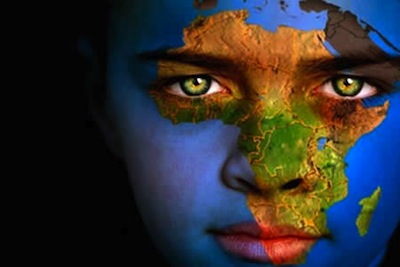
06 Feb Ethiopia Makes Me Wonder: Is Being Trinidadian Enough?
Ethiopia Trip
Day Four
She dismissed me mid-sentence, and demanded…
“You! What is your name? Where are you from? ”
I was totally taken aback by this little girl. How she bold so?
I spoke slowly and pointed to my chest … “My name is Kevin. I am from Trinid…”
Before I could answer, she grabbed my wrist and pulled me through the maze that was the little Ethiopian village where we were staying.
All the neighbours watched from their yards. She eventually lifted a heavy curtain, and I saw an ancient looking Ethiopian woman. My lungs were stressed…They walk fast here!
After an animated exchange, the old woman swung her head toward me.
She grabbed my chin pushed it left, then right….
In her pieced-together English she announced, “”West…West Africa!”
——————————–
Later that night, and with a broad smile, our interpreter informed us that my arrival with the Habitat for Humanity team had been a topic of heavy discussion amongst the Ethiopian villagers. In a private talk, even later, he explained to me that the villagers had become accustomed to hosting white European and American volunteers.
Of our team of twelve, I was the only Black man…and I was the youngest.
Somehow, the villagers had worked out that I wasn’t American. Several of the men, according to the interpreter, had asserted, “He is one of us.”
And so, as my exchange with the little girl and the old woman on day four of my trip ended the speculation of some of the villagers, it ignited my own dormant questions.
For the first time, I considered the totality of my experience as a young black man in this world, and wondered…Is identifying as a Trinidadian enough for Trinidad’s African descendants?
———————————-
Ethiopia Trip
Day Ten
In discussions with some of the Ethiopian villagers, I am learning the importance of having a real understanding of one’s ancestral heritage.
The smallest Ethiopian child seems able, with a trance-like detachment, to recount their familial lineage back five, sometimes six generations.
I know nothing of my great grandmother or grandfather on either of my parents’ sides.
————————————
I’ve become fascinated by the idea of cultural heritage, and the role it plays within the multicultural diaspora that is the Caribbean community. I am particularly curious as to whether other young African Trinidadians feel, or even think about the fact that not very many of us can trace our African roots, pre-Trinidad.
Is there a disconnect between African Trinidadians and Africa? If so, how has this disconnect hurt us? How important is it for African Trinidadians to have a real and direct connection to the motherland? Can such a connection contribute to easing race relations in our beloved country?
The recent controversy involving Opposition leader Dr. Keith Rowley’s objections to the Prime Minister’s actions during her recent state visit to India is evidence that the issue of cultural heritage, as it relates to national identity, is one that continues to be at the forefront of Trinidadian consciousness.
Compared to other cultures that make up the Trinidadian landscape, particularly the East Indian culture (which accounts for a significant portion of the Trinidadian population), I would like to suggest that African culture is like a teenage girl, who, still wearing a training bra, is unsure of her development, and is trying to find her comfort zone, or assert herself, in the midst of her already-developed peers.
While other cultures have been able to maintain direct links to their source, and thus further evolve into their uniquely Caribbean versions, the resulting tangible disconnection of slavery has rendered the African culture somewhat stunted. She is still in her training bra.
When I read articles like the one in the Daily Herald, which highlights the belief that national identity hinges on country only, and not necessarily on heritage, or I hear Afro-Trinidadians muttering similar sentiments, I see the African cultural disconnect on unvarnished display.
If you have ever wondered about the effects of slavery on African-Caribbean, African-American, and African-Latino people, I invite you to carefully reread the article for a nuanced example of its manifestation in contemporary Caribbean life.
Slavery has managed, over time, and all at once, to sever African people born and raised outside of Africa from the tangible links that bind them to the motherland, while facilitating a level of disassociation that doesn‘t allow for very much acknowledgement of a decidedly African lineage.
African influences on religion, food, fashion and music, while very much a part of day-to-day Caribbean living, inevitably disintegrate into superficiality, as the cultural origin and context dissipates.
One has only to take a casual look at Trinidadian media, Outlish Magazine included, to find countless examples of ongoing dialogue pondering the “decline” of regional staples, like Carnival and Calypso music, into their modern-day reinterpretations. When all is said and done, many people in the region feel that these staples have been reduced to their lowest common denominator, which, particularly for Carnival, translates into a good time to be had once a year.
Can the gradual disassociation of Caribbean norms from their African roots be cited, as one of the many contributing factors to this “decline“ of which we speak?
Black History month offers an excellent opportunity to examine this cultural castration from an international perspective.
For the most part, at least for me, Black History Month chronicles the civil rights struggle, and to a lesser extent, the struggle of the westernized Black (interestingly, not African) man and woman out of the era of slavery. Surely, references to the African historical dynasty that predates slavery exist. Yet westernized Backs, including Afro-Trinidadians, seem conspicuously disengaged and disassociated with the totality of the African historical spectrum. We, and a lot of other people, seem fixated on only part of the entire story – slavery and colonialism.
Unlike our East Indian brothers and sisters, who balance a dynamic interplay of identifying as Trinidadian, and being of India, most African Trinidadians I know, because of the disconnect, identify as being Trinidadian…of Trinidad.
Is some kind of interplay, then, an integral component in counteracting the cultural decline that we mentioned earlier?
My trip to Ethiopia was incredibly eye -opening in illuminating the necessity of accessing the knowledge, and actively engaging the cultural norms of my ancestors. My direct exposure to African life has, at the same time, validated my African and Caribbean sensibilities. Suddenly, seeing my grandmother sweeping her yard with a cocoyea broom, took on an entirely different meaning, once I understood that this seemingly simple act is one that has been practised for generations in Africa.
Therein lies the magic of historical and cultural perspective. It elevates the daily routines we take for granted. In the interest of elevating Trinidadian and Caribbean culture, which is an amalgamation of all cultures – African, Indian, Asian, Spanish, Middle Eastern, European, etc, it is in everyone’s interest, particularly our political representatives, to promote Trinidad, as a place where such cultural exploration is not only possible, but is a way of life.
Image credit: sfcg.org
Look out for a new issue of Outlish.com every Monday!
Stalk us on Facebook @facebook.com/outlishmagazine

In a past life, Kevin Campbell was an incredibly talented force to be reckoned with. In this life? Not so much. Born and raised in Trinidad, Kevin has been living in Toronto since 1998. Architectural designer by trade, notorious skylarker by passion, he is also an avid proponent of exchanging ideas and media, having also pursued communication studies at the University of Ottawa. In his spare time, Kevin enjoys ah good ole talk, and ah good party/palance combo!
Twitter •
RR29
Posted at 11:07h, 06 FebruaryKevin, I always look forward to your entries because they touch on so many subjects and topics unbiasedly. This one, “Ethiopia Makes Me Wonder: Is Being Trinidadian Enough?” is by far, your BEST. I am happy to know that they embraced your presence, and out of your trip, you were able to link your ancestral lineage to W. Africa. As for the polarization and dilution of our heritage, we, the younger generation have the tools and the means to preserve our culture, and hopefully we DO so because there is definitely a decline in its preservation. GREAT JOB on the article, at least you got to fulfill the mecca of African descendants, a trip to the motherland, a once in a lifetime opportunity;)
Thanks for the share!
Barefoot Contessa
Posted at 03:22h, 16 Marchonce you are an african, ethiopia is your home.
Janine Charles-Farray
Posted at 10:23h, 31 JulyThank you, Kevin.
Tamara Walker
Posted at 10:47h, 31 JulyGreat article. Definitely something that makes one think. With Trinidad, and most of the Caribbean, being a hybrid of cultures I often wonder if our African heritage is overlooked. Thank you for highlighting why we should appreciate it.
Higherheights
Posted at 14:17h, 01 AugustWOW, just WOW. I love this Article!
Kam L-Griffith
Posted at 14:19h, 01 AugustWOW, Gives you alot to think about! How do we go about making sure the authenticity of our African heritage and culture does not get lost in the modern times and that we elevate African culture from training bra status.
Janelle Simon
Posted at 19:42h, 01 AugustI am by no means as eloquent as the writer but I do feel very strongly that if Trinidadians did more to concentrate on our history and our culture instead of looking into the past (which I believe is so uncertain) then they would realise that being Trinidadian is certainly enough.
My motherland is Trinidad. yes my great grand parents and great great grand parents are of different heritage (african and european)but therein lies the beauty of what made me – and it certainly is enough.
I wish I was able to better express how deeply I feel about how important it is to embrace what makes us unique as a people.
Yes our fore fathers habituated these islands because of slavery and that is precious in the root of our identity. The history of Trinidad and Tobago is young compared to the continents but that does not make it any less significant. I feel that embracing our history and holding it dear is priceless.
When someone asks me where I am from because they are trying to ascertain my identity, I tell them ” I am from TRINIDAD AND TOBAGO. A twin island republic in the Caribbean …….. It’s between north and south America.” i have to do this frequently and i say it with great pride and certainty before going on to give a brief of where my people have come from.
It is my hope the every Trinidadian expresses with great clarity …..”No I am not African, no I am not Indian not Chinese, not ……. I am Trinidadian. Pointe finale.
Liselle Fraser
Posted at 20:01h, 01 AugustWell said Jan 🙂